

air
nanofibre membranes
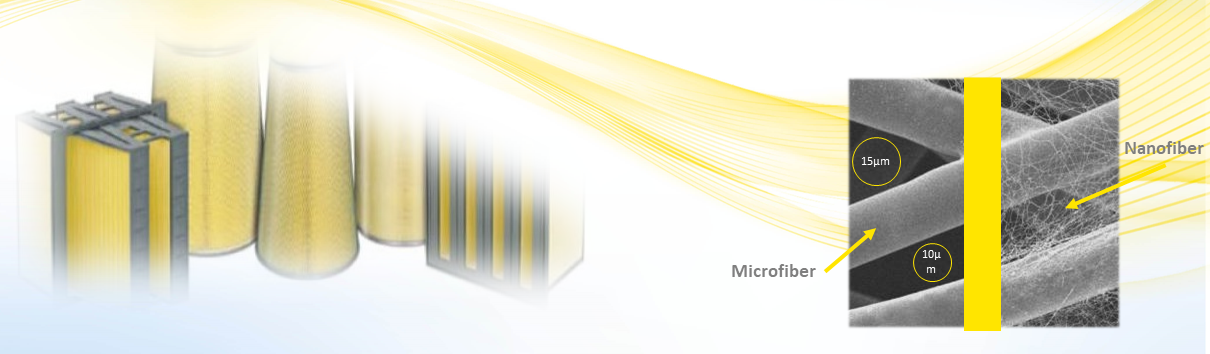
produced by electrospinning technology are considered as excellent air filter media
Main advantages
The main advantages of nanofibres in air filtration
- very small fibre diameter
- high surface to volume ratio
- high porosity
- small pore size
- excellent homogeneity of fibre distribution
- narrow distribution of fibre diameters
standards
Filtration efficiency vs. pressure drop
The two most important parameters required by European and international standards (ISO 16890, EN 1822/ISO 29463) are filtration efficiency and pressure drop. Ideally, the filter with the highest filtration efficiency and the lowest pressure drop is the most desirable.
It is this combination of low dP (high air permeability) and increased filtration performance without the need for any electrostatic charge that makes nanofibre materials superior to conventional charged synthetic and silica glass fibre media.
Example
case study
The correlation between air permeability vs. filtration efficiency on the example of PA6 nanofibre coating on a 30 gsm PP Spunbond carrier for different layer thicknesses, measured on a Palas PMFT 1000 test rig using DEHS aerosol at 95 l/min, 100 cm2 . The corresponding filter class (according to old EN 779 and current ISO 16890) is given in the table on the left.
GSM
Area weight vs. filtration parameters
The empirically calculated area weight of the nanofibrous layer (excluding the weight of the substrate) for the above scenarios (PA6 to 30 gsm PP-SB) is shown on the X-axis of the graph. The Y-axes then show the achievable AP and FE for this nanolayer.
Alternatives
Possibility of different substrates for coating
Comparable FE vs. dP results can be achieved with a variety of other polymers on various other support media (up to 1.6m wide), such as:
- cellulose/synthetic blend papers
- Meltblown
- Spunlace
- Spunbond
- Needlepunch
- and other...
The nanofibre layer can be laminated with a protective layer and the composite is suitable for pleating (see picture left)